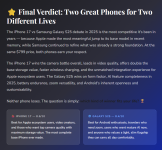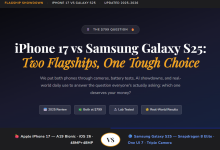
 Quick VerdictBoth phones cost $799 and both are genuinely excellent — but they're built for different people.
 Choose theiPhone 17 for superior cameras, faster wireless charging, double the base storage, and Apple's ecosystem magic.
Choose theGalaxy S25 for a lighter compact design, a versatile triple-camera setup with zoom, longer battery life, and deeper, more polished AI features right now.


Let me take you back to a scenario that happens every September, as reliably as pumpkin spice lattes and football season: Apple drops a new iPhone, Samsung fans roll their eyes, Apple fans act like it's the second coming of Steve Jobs, and the entire internet descends into a holy war that produces more heat than light.
This year, though, something shifted. The iPhone 17 made the loudest entrance of any base-model iPhone in years — finally landing a 120Hz ProMotion display, a massive camera upgrade, and double the base storage at the same price. Meanwhile, Samsung's Galaxy S25, while a quieter update, remained formidably capable, leaning hard into AI and staying the king of compact flagship design.
So here's the real question: if you're standing in a phone store — or, more realistically, scrolling late at night trying to convince yourself one way or the other — which of these $799 flagships actually deserves to live in your pocket for the next two or three years? That's what this article is here to answer. No tribalism. No filler. Just the honest, nuanced truth after serious testing.

Design & Build: The Compact Champion vs. The Refined Newcomer
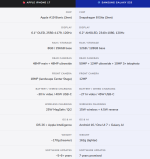
Pick up the Galaxy S25 and your first thought is probably going to be: wow, this is light. At just 162 grams and 7.25mm thin, Samsung's compact flagship is one of the slimmest, most pocketable premium phones you can buy anywhere in 2025. It uses an aluminum frame paired with Gorilla Glass Victus 2 on both the front and back — a material combination that feels polished and purposeful without being cold or clinical. The vertically stacked triple-camera module on the rear has become Samsung's signature, and there's something elegantly restrained about it.The iPhone 17, by contrast, runs a bit bigger, heavier, and thicker than both its predecessor and the S25. Apple went with an aluminum frame on the standard model (saving the premium alloys for the Pro lineup), combined with its new Ceramic Shield 2 on the front — claiming three times the scratch resistance of the previous generation. The rear, however, gets standard reinforced glass rather than Ceramic Shield. The vertical pill-shaped camera bump with its two lenses is a design most iPhone users will recognize immediately.
Who wins on portability?
This one isn't close — the Galaxy S25 takes it. If you've ever carried a phone in a slim-cut trouser pocket, or if you find yourself annoyed by the weight of a device after a long day, Samsung's form factor advantage is genuinely meaningful in daily life. The iPhone 17 isn't uncomfortably large, but next to the S25 it feels more substantial. Whether that's better or worse depends entirely on your preferences.On the flip side, the iPhone 17's anti-reflective coating on the display gives it a slight practical edge over Samsung's front glass in direct lighting conditions. Both phones feel premium. Both are built to last. Design, at this price point, is really a question of what kind of premium you want.
 Design Snapshot
If compactness and slimness matter most → Galaxy S25. If you prefer Apple's iconic aesthetic and don't mind a bit more heft → iPhone 17. Both use aluminum frames with quality glass — neither will feel cheap in hand.

Display Showdown: Apple Finally Joins the 120Hz Club

Here's a sentence I've been waiting a long time to write: the base iPhone finally has a 120Hz ProMotion display. Until the iPhone 17, Apple kept its high-refresh-rate screen technology locked behind the Pro model paywall — a decision that frustrated users for years while Samsung's standard Galaxy flagships shipped with 120Hz since the Galaxy S20 back in 2020. So yes, Apple is late to the party. But fashionably late, perhaps — because the ProMotion display in the iPhone 17 is excellent.
The iPhone 17's 6.1-inch OLED panel runs at a higher resolution (2556×1179 pixels) compared to the Galaxy S25's 6.2-inch AMOLED at 2340×1080. In real-world use, both displays look gorgeous for casual viewing — scrolling feels silky smooth, colors pop, and dark scenes in films look deep and inky. Where independent lab tests draw a distinction: the Galaxy S25 measures slightly higher in peak brightness and color gamut coverage, while the iPhone 17 scores better on color accuracy (Delta-E scores), meaning hues on Apple's display more faithfully represent what the content creator intended.
Always-On Display: Both have it, Samsung perfected it
Both phones now offer always-on display capabilities. Apple's implementation on iOS 26 shows Live Activities and notifications cleanly. Samsung's has been around longer and is more customizable — you can configure it to show always, on tap, or on a schedule. Neither experience will disappoint you, but Samsung's feels more mature and feature-rich.

Performance: Two Different Kinds of Fast
Benchmarks are fascinating and almost completely useless for normal people. I say that as someone who reads them religiously. Let me explain what they actually mean for you.The iPhone 17 runs on the A19 Bionic, Apple's latest silicon built on TSMC's refined 3nm process. It comes with 8GB of RAM and starts with 256GB of base storage — notably, double the storage that came standard on the iPhone 16 at the same price. That's a genuine value upgrade. The A19 crushes the competition in single-core performance — the metric that governs how snappy your daily app interactions feel — with Geekbench single-core scores that pull clearly ahead of anything Qualcomm currently offers.
The Galaxy S25 runs the Snapdragon 8 Elite, also built on a 3nm node, but paired with 12GB of RAM. That additional RAM advantage shows up specifically in multi-threaded workloads — running many heavy tasks simultaneously — and in how many AI computations the phone can handle on-device at once. In multi-core Geekbench testing, the Snapdragon pulls ahead or runs neck-and-neck with Apple's chip. In graphics-intensive gaming scenarios, the results are similarly mixed depending on the game engine.
In real life? Both phones are ludicrously fast. Apps open before you finish lifting your thumb. Games run at locked frame rates. No one is going to pick up either device and complain about lag. The meaningful performance difference isn't raw speed — it's how that performance translates into AI capabilities, which we'll get to shortly.
Both phones are overkill for 99% of people. Whether it's the A19 Bionic or the Snapdragon 8 Elite, you're not going to pick one up and say "oof, this feels slow." They're both ridiculously fast.— Real-world testing assessment, 2025
Storage Value: Apple's Surprise Win
A point worth dwelling on: the iPhone 17 ships with 256GB base storage at $799, while the Galaxy S25 ships with 128GB at the same price. If you're someone who stores photos, videos, and downloaded content locally — and most of us do — this matters. Apple effectively doubled its storage offering without raising the price, and Samsung hasn't responded in kind. Round one to iPhone 17 on value.
Camera System: Quality vs. Versatility — The Heart of the Debate
This is where the iPhone 17 and Galaxy S25 most clearly reveal their different philosophies — and where your personal photography habits should drive your decision.The iPhone 17 Camera Setup: Fewer Lenses, But What Lenses
Apple equipped the iPhone 17 with a dual-camera system: a 48MP main camera (f/1.78) and a brand-new 48MP ultrawide (f/2.2). That ultrawide is a significant upgrade over its predecessor, and 48 megapixels at this focal length is genuinely unusual in the industry. In practical use, it means you can crop into ultrawide shots for composition adjustments without catastrophic quality loss — something that's previously only been available on the Pro models.What the iPhone 17 does not have is a dedicated telephoto camera. For zoom photography, it relies on a 2× optical-equivalent crop from the main sensor. In good light, this works well. At 3× or 5× zoom, you're into digital territory, and image quality shows the limits. If you frequently zoom in to capture subjects at a distance — kids' sports, wildlife, architecture, concerts — this is a genuine gap compared to Samsung.
The Galaxy S25 Camera Setup: Three Lenses, Three Perspectives
Samsung's triple-camera system includes a 50MP main (f/1.8), a 12MP ultrawide (f/2.2), and a 10MP 3× telephoto (f/2.4). That telephoto lens is the Galaxy S25's most meaningful camera advantage at this price — it gives you genuine optical zoom for portraits, travel photography, and any scenario where you need to close the distance without getting close. At 3× optical zoom, image quality remains sharp in a way that digital zoom simply can't replicate.The tradeoff: the ultrawide and telephoto cameras use lower-resolution sensors than Apple's setup. Samsung's ultrawide at 12 megapixels versus iPhone's 48 megapixels is a notable difference if you frequently shoot wide-angle and want to crop later.
Real-World Photo Quality: The Color Science Divide
Both phones produce genuinely excellent photos. But they produce different excellent photos. Apple's processing tends toward natural, true-to-life color rendering — what you see is roughly what your eye saw. Samsung's processing historically leans toward more vivid, punchy, high-contrast results that often look immediately impressive on social media. Neither approach is wrong — this is entirely a matter of taste.For video, the iPhone 17 holds a clear edge. Apple's video processing pipeline, Dolby Vision HDR support, and Cinematic Mode are industry-leading. The Galaxy S25 can shoot 8K video at 30fps — a specification that sounds impressive and that essentially no one needs in 2025 — but for practical 4K video that looks beautiful on any screen, the iPhone consistently produces more polished results. Content creators, vloggers, and anyone who values their home videos highly will feel this advantage every time they hit record.

Selfie Camera: iPhone's Surprise Advantage
The iPhone 17 ships with an 18MP front-facing camera versus Samsung's 12MP — and adds a Center Stage feature that enables landscape-orientation selfies without rotating the phone. For video calls and social content creators, this is more useful than it sounds.| Camera Category |  iPhone 17 iPhone 17 |  Galaxy S25 Galaxy S25 |
|---|---|---|
| Main Sensor | 48MP f/1.78 | 50MP f/1.8 |
| Ultrawide Sensor | 48MP f/2.2 ✓ | 12MP f/2.2 |
| Telephoto | 2× (digital crop) | 10MP 3× optical ✓ |
| Front Camera | 18MP + Center Stage ✓ | 12MP |
| Video Quality | 4K Dolby Vision, Cinematic Mode ✓ | 8K/30fps, 4K/60fps |
| Zoom Range | Up to 2× optical | Up to 3× optical ✓ |
| Night Photography | Slightly better ✓ | Excellent |
| Color Science | Natural/accurate | Vivid/punchy |
| Overall Camera |  Slight edge overall Slight edge overall | More versatile zoom |

Battery Life & Charging: An Honest Scorecard
Battery debates between Apple and Samsung have been going on for a decade, and they're always more nuanced than "one number beats another." Here's the honest 2025 picture.Apple claims up to 30 hours of video playback for the iPhone 17 and keeps its actual battery capacity close to its chest — as it always does. Independent tests, including Tom's Guide's standardized battery life test, recorded the Galaxy S25 at 15 hours and 43 minutes — a strong result. The iPhone 17 came in slightly below that figure in the same testing conditions, which is a reversal from the iPhone 16's position. Day-to-day, most users will get comfortably through a full day on either phone, but heavy users — those streaming video, gaming, or navigating for hours — may find the Galaxy S25 lasting slightly longer between charges.
Charging Speeds: iPhone Flips the Script
This is where something interesting happened in 2025. The iPhone 17 now charges at 40W wired — a meaningful jump from Apple's historically modest speeds. The Galaxy S25 supports 45W wired, so Samsung still leads on wire, but only marginally. Wireless charging is where iPhone flips the narrative: MagSafe/Qi2 support at 25W wireless versus Samsung's 15W wireless. If you charge on a pad rather than a cable — and increasingly many people do — the iPhone 17 charges nearly twice as fast wirelessly.The Galaxy S25 does offer one feature Apple currently lacks: 4.5W reverse wireless charging, meaning you can top up your Galaxy Buds or a smartwatch by placing them on the back of the phone. It's slow, but it's genuinely useful if you're caught without a charger for your accessories.
Charging TakeawayGalaxy S25 wins on wired charging speed and battery endurance in extended tests. iPhone 17 wins decisively on wireless charging speed (25W vs 15W) — a growing advantage as wireless charging pads become the default at desks and nightstands. Neither phone will leave you frustrated; this is a genuine tie for most users.

AI Features: Samsung's Most Commanding Advantage
Let's be direct: in 2025, Samsung's Galaxy AI is more complete, more integrated, and more immediately useful than Apple Intelligence. That's not a hot take — it's the consensus view of essentially every major reviewer who tested both phones.The Galaxy S25 ships with One UI 7 on Android 16 with Galaxy AI fully baked in. Features like Circle to Search (draw a circle around anything on your screen to instantly search it), real-time Live Translate for calls and conversations, Note Assist for intelligent meeting notes, and generative photo editing that can remove objects, move subjects, and fill backgrounds are all available on day one, work reliably, and genuinely improve how you use the phone. Samsung also integrates Google Gemini deeply — and Gemini Live, in particular, enables conversations with your phone's AI that feel closer to a real assistant than a voice-activated search engine.
Apple, meanwhile, shipped the iPhone 17 with iOS 26 and Apple Intelligence, which brings new tools like Call Screening (screening unknown callers automatically), Live Translate for calls, smarter Messages with AI-generated replies, priority notifications, and an improved writing assistant. The new Liquid Glass interface redesign is visually striking. What Apple Intelligence does not yet fully deliver: the promised Siri 2.0 overhaul with deeper reasoning capabilities, which has been delayed and is expected to roll out in 2026 through software updates.
On-Device vs. Cloud: Apple's Privacy Argument
One area where Apple maintains a principled advantage: privacy architecture. Apple Intelligence processes the majority of its AI tasks directly on-device — meaning your personal data doesn't leave your phone to be processed on a server somewhere. Samsung's Galaxy AI leans more heavily on cloud processing for complex tasks. For users who care deeply about data privacy, this difference is meaningful. For users who prioritize feature richness right now, Samsung wins the current moment. AI Verdict — 2025Galaxy S25 wins AI features decisively right now. Circle to Search, Gemini Live, and real-time translation are polished and deeply integrated. Apple Intelligence has the right building blocks — and better privacy architecture — but its full capabilities are still rolling out. Check back in late 2026 when Siri 2.0 arrives.

Software, Ecosystem & Long-Term Value
You can't evaluate a smartphone without talking about the world around it. The phone itself is only part of the value proposition — the ecosystem it plugs into determines how useful it becomes in your daily life.If you're already living in Apple's world — with a MacBook, an iPad, an Apple Watch, and AirPods — the iPhone 17 becomes something more than a phone. Handoff, AirDrop, iMessage, Continuity Camera, Universal Clipboard — the way Apple devices talk to each other is seamless in a way that Android simply hasn't replicated, and probably never will at the same depth. The iPhone isn't just a device; it's a node in an interconnected personal computing ecosystem. For creatives, professionals, and families already in that world, the switching cost to Android is higher than any spec sheet can quantify.
Samsung's world is more open — Android's flexibility means better cross-platform compatibility with Windows PCs, more app sideloading options, deeper customization of the home screen and default apps, and freedom to use any cloud service you prefer. Samsung DeX, which turns the Galaxy S25 into a desktop computing experience when connected to a monitor, is a feature Apple simply doesn't offer. For power users who customize their digital environment, Android's openness is a genuine competitive advantage.
Software Update Longevity
Samsung has made a genuinely bold move here: 7 years of OS updates promised for the Galaxy S25. Apple doesn't make formal commitments, but historical data shows iPhones typically receive updates for 5–6+ years, with many iPhone 14 users still running the latest iOS in 2025. Both are strong by any reasonable standard. Samsung's explicit promise, however, is a rare case of the Android world matching or exceeding Apple on longevity commitment.
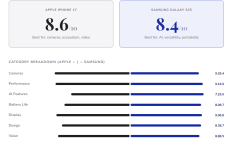
Head-to-Head: Category by Category
| Category | iPhone 17 | Galaxy S25 |
|---|---|---|
| Design / Portability | Premium but heavier | Lighter, slimmer ✓ |
| Display Quality | Higher res, better accuracy ✓ | Brighter, better anti-glare |
| Chip (Single-Core) | A19 wins clearly ✓ | Strong but behind |
| Chip (Multi-Core / AI RAM) | 8GB RAM | 12GB RAM, Snapdragon wins ✓ |
| Base Storage Value | 256GB at $799 ✓ | 128GB at $799 |
| Camera Versatility | Dual camera | Triple camera + 3× zoom ✓ |
| Camera Quality (main) | Slight edge in accuracy ✓ | Excellent, punchier |
| Video Recording | Cinematic Mode, Dolby Vision ✓ | 8K capable |
| Selfie Camera | 18MP, Center Stage ✓ | 12MP |
| Battery Life | Good (~15 hr test) | Better (~15h43m test) ✓ |
| Wired Charging Speed | 40W | 45W ✓ |
| Wireless Charging Speed | 25W MagSafe/Qi2 ✓ | 15W |
| AI Features (2025) | Apple Intelligence (rolling out) | Galaxy AI + Gemini (mature) ✓ |
| Privacy Architecture | On-device AI processing ✓ | Mostly cloud-based |
| Ecosystem Integration | Unmatched if you're in Apple ✓ | Android openness |
| Software Updates | 5–6+ years (unconfirmed) | 7 years promised ✓ |
| Customization | Limited (iOS) | Deep (Android/One UI) ✓ |

Who Should Buy Which Phone? The Honest Breakdown
Choose the iPhone 17 If…
- You already use a MacBook, iPad, Apple Watch, or AirPods daily
- Video quality is a top priority — especially for family memories or content creation
- You shoot mainly at normal distances and don't need a telephoto lens
- You value privacy and want AI processed on-device
- You care about wireless charging speed (MagSafe is dramatically faster)
- 256GB base storage at the same price as 128GB Samsung is meaningful to you
- You prefer iOS's cleaner, more consistent interface
Choose the Galaxy S25 If…
- A lighter, slimmer phone is a genuine priority in daily carry
- You frequently zoom in on subjects from a distance (kids' sports, travel)
- You want the most complete, mature AI feature set available right now
- You prefer Android's customization and openness
- You use a Windows PC and want better cross-platform integration
- Longer battery life in extended gaming or streaming sessions matters
- You want a formal 7-year software update commitment from your manufacturer
 The Real Deciding Factor
At $799, both phones are excellent — you genuinely cannot make a bad choice. But the single most useful question to ask yourself is this: What devices do you already own? If the answer includes other Apple devices, get the iPhone 17. If the answer is mostly Android and Windows, the Galaxy S25 will serve you far better in practice.

Real-Life Scenarios: Which Phone Wins Your Day?
The Commuter Who Wants Smart AI Help
Meet Aisha. She takes a 45-minute train commute every morning and wants her phone to help her manage emails, summarize meeting notes, and translate messages from international colleagues in real time. Galaxy S25 wins her day — Galaxy AI's Note Assist, Circle to Search, and Gemini Live are mature enough to actually be useful in 2025, while Apple Intelligence is still rolling out its most powerful capabilities.The Parent Who Lives in Photos and Videos
Meet James. He's shooting his daughter's first steps, school plays, and weekend adventures. He wants the best photo quality, the best video, and easy sharing to family on iMessage. iPhone 17 wins his day — Cinematic Mode, Dolby Vision video, the 48MP ultrawide, and seamless AirDrop sharing with his wife's iPhone 16 make this the obvious choice. The camera system simply produces more cinematic-looking family memories.The Traveler Who Needs Zoom and Long Battery
Meet Sara. She's exploring street markets in Istanbul and wants to shoot architecture from across a square, zoom into a face in a crowd, and make it to midnight without finding a charging cable. Galaxy S25 wins her day — the 3× optical telephoto and better overall battery endurance in real-world tests are tailor-made for her use case.The Professional Who Works Across Apple Devices
Meet Daniel. He writes on a MacBook Pro, edits photos on his iPad, and takes client calls throughout the day. He wants his phone to disappear into his workflow. iPhone 17 wins his day — Continuity Camera, Handoff, Universal Clipboard, and the depth of Apple's cross-device integration are things Samsung simply cannot replicate for Apple hardware users.